
1917–1918 The United States Joins the Fight
Greenwich Serves
In the weeks following America’s declaration of war, voluntary enlistment did not meet the needs of the military and so President Wilson called for a draft. The Selective Service Act of 1917 specified that those men between the ages of 21 and 31 register with local boards. In Greenwich 2,218 men signed up on Conscription Day, June 5.
As international tensions mounted, former President Theodore Roosevelt and others raised an alarm—a robust standing army was needed to replace state-organized National Guard units. Advocates of a strong military mounted the first formal “Business Men’s Camp” in upstate New York in 1915. This summer school for civilians offered officer training and physical fitness workouts. Participants were primarily elite, middle-aged men who could afford to attend and included Raynal Bolling and Allan Kitchel of Greenwich. In November Bolling organized the Aviation Detachment, First Battalion, Signal Corps of the New York National Guard, marking the Guard’s first aviation unit.
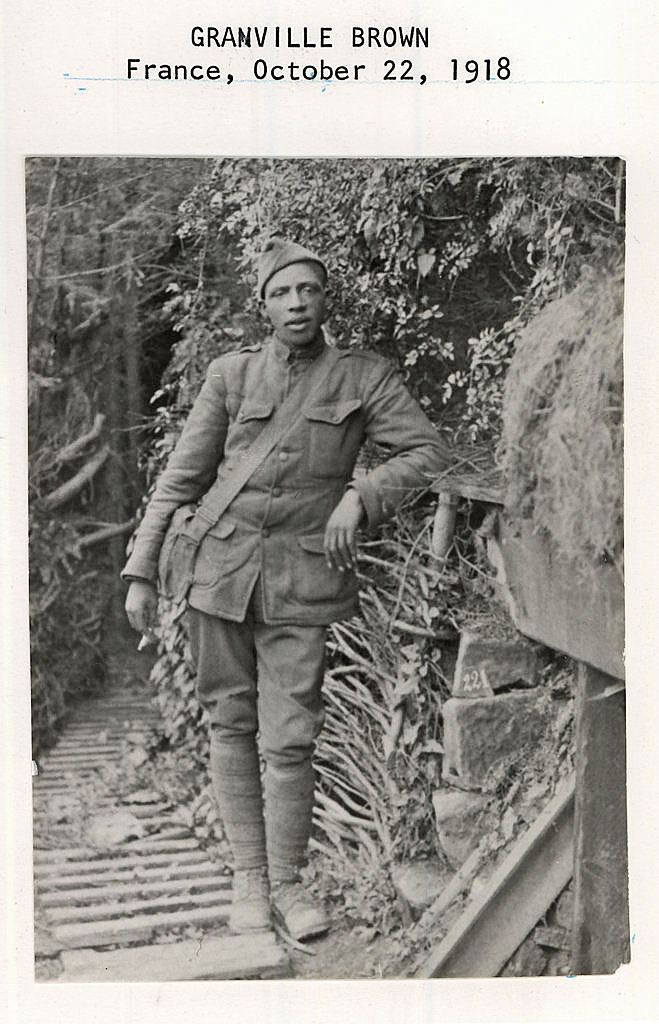
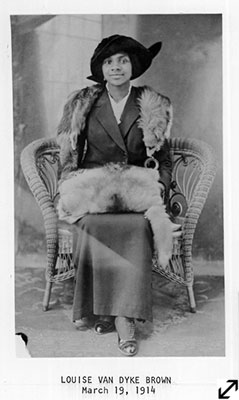
Louise Van Dyke Brown and Granville Brown, 1914 and 1918. Photographs from the personal collection of Louise Van Dyke Brown. Courtesy of the Greenwich Library Oral History Project.
In an oral history conducted in 1978, Louise Van Dyke Brown remembered that two of her brothers enlisted in the Navy and her oldest brother was drafted into the Army. Her future husband, Granville Brown, was in the Army and stationed in Europe. He was a member of the 92nd Infantry Division (Colored).
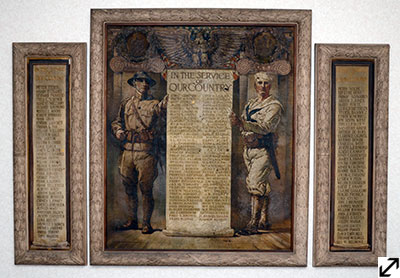
Edward M. Ashe (1867-1941). Lend the way they Fight, Buy Bonds to your UTMOST, 1918. Lithograph. Printed by The W.F. Powers Co. Litho. N.Y. Greenwich Historical Society, William E. Finch, Jr. Archives.
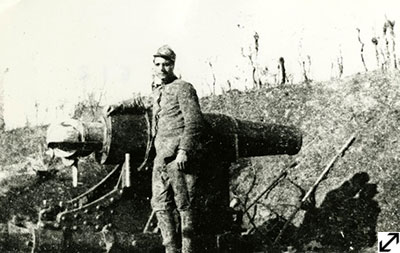
Pietro Buccieri, c. 1915. Courtesy of Pietro Buccieri’s family.
Not all from Greenwich served in the American Expeditionary Force. Some men fought for Italy after it joined the Allied Powers in 1915. Mary Mainiero Margenot recalled how men who had come to Greenwich to work as laborers and had lived near her had returned to their homeland to fight. She recalled sadly that many were killed.
By the end of World War I, the idea of immigrants possessing strong loyalty to their ethnic origins as well as to the United States was not looked on with favor.
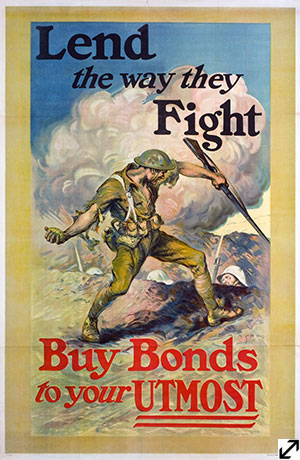
Edward M. Ashe (1867-1941). Lend the way they Fight, Buy Bonds to your UTMOST, 1918. Lithograph. Printed by The W.F. Powers Co. Litho. N.Y. Greenwich Historical Society, William E. Finch, Jr. Archives.
Although by no means a modern strategy, trench warfare dominated the European war zone. Armies on both sides occupied miles of ditches constructed with embankments and topped with barbed wire designed to stop the advance of enemy soldiers. Life in the trenches was marked by claustrophobic conditions, vermin, standing water and long periods of boredom between battles.